The English Standard Playing Card
The pattern of the modern English playing card derives from an influential design originating in Rouen, France in the 15th century. Like all standards, the English Pattern has defining elements which set it apart from other patterns. These defining elements can be found among the objects, weapons, and attire assigned to each of the characters of the Royal household. Manufacturers and card houses have kept to this form of the English pattern for well over 370 years now, more or less preserving the assignment of objects and weapons. Each one, in producing their own face cards, exhibit interpretations that pattern, and, despite a wide variation in style, colour and detail, nonetheless conform to the pattern.
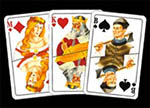
The examples below show renditions of the English Standard, and other patterns from Europe.
Further Reading
The English Pattern
Regional Patterns of 18th Century France
Gallery of Early Standard Playing Cards
L I N K S
Delcine of English Court Cards - International Playing Card Society.
The Paris Pattern - Courtesty the World of Playing Cards.
Expos� of early and contemporary European Standards - DXPO Playing Cards.
Celebrates the English Standard Playing Card as a cultural icon - Paul Bostok's PlainBacks.com
|

 American Standard
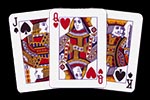 Modiano
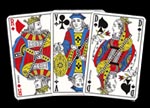 Paris Pattern
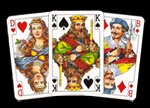 Danish Standard
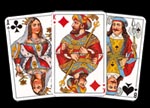 Russia
 Lithuanian